Teaching and learning
We are passionate about the quality of our teaching. As a school, this is at the centre of everything we do.
Starts of lessons
At the start of every lesson, all our teachers greet students at the door.
We wear pink high-vis vests and settle students as they arrive. This helps to manage a calm changeover and give students a positive start.
Every lesson has a "Do Now" starter activity. This is typically a quiz on key knowledge they have previously learnt. Regular retrieval practice helps students remember knowledge over time.
High participation
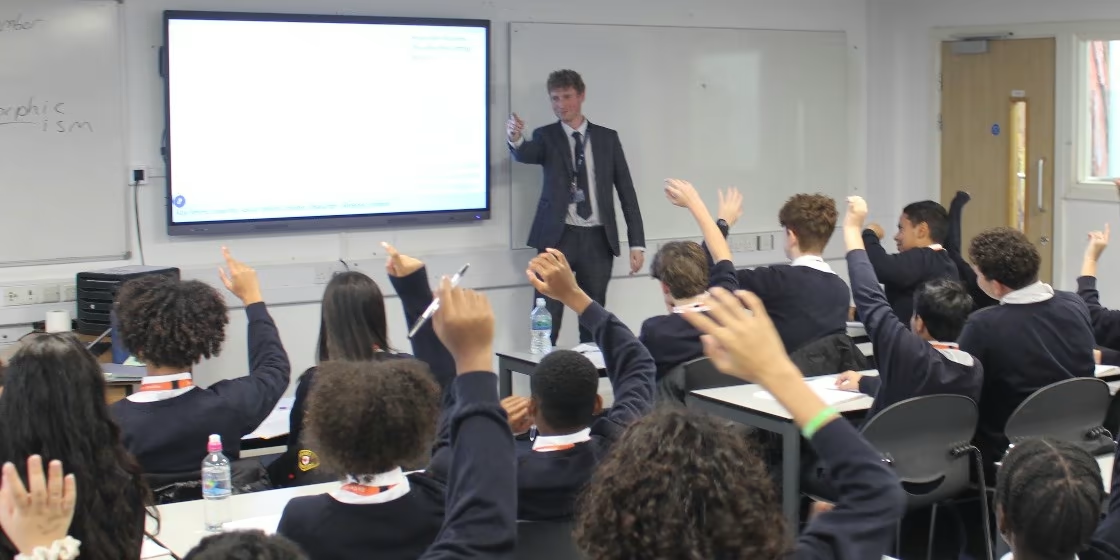
Students learn best by actively engaging in lessons, rather than passively listening.
Whole-class teaching time
When explaining a new concept, we use lots of questioning. This checks that students are listening and that they understand the material. It also helps us adapt our teaching and address misconceptions.
Our high-participation techniques include:
- Mini whiteboards
- Turn and talk
- Think, pair, share
- Quick poll
- Call and response
- Stop and jot
On-task learning time
We also set aside lots of time for students to complete knowledge acquisition and deliberate practice tasks. These are opportunities for them to think hard on their own or rehearse practical skills.
Teachers circulate to provide individual feedback, creating a vibrant heatmap of support.
Behaviour for learning
Students learn best in calm, welcoming classrooms where they feel safe, respected, and ready to learn.
Our teachers apply the "ABC" principles:
- A — Assertive with explicit expectations
- B — Best conduct gets first attention
- C — Calm, consistent, and de-escalatory
Every student has the right to learn without disruption. Teachers manage this with least invasive interventions, such as nonverbal cues or using a student's name. If disruption continues, teachers may take further action, including a clear warning or removal from the classroom when necessary. This protects the learning of others.
Students who participate well can earn Q-Points, or even Star of the Lesson, to reward their efforts.
Inclusive teaching
Students learn best when lessons are adapted to their different strengths, needs, and starting points.
We know our students well and tailor our teaching to help everyone learn.
For example, we:
- make accommodations for students with physical and sensory needs
- support students to access the literacy and numeracy demands of lessons
- deploy teaching assistants to provide personalised support for those who need it
- give additional prompts, scaffolding, or support
- provide greater challenge for students who are ready to move further
- gradually reduce support to help students become more confident and independent
Professional learning
As educationalist Dylan Wiliam explains:
"Every teacher needs to improve, not because they are not good enough, but because they can be even better."
We are strongly invested in all our staff. Teachers and teaching assistants benefit from regular CPD to strengthen their knowledge and skills. This is led by departments, senior leaders, and experts in our Trust.
Early career teachers receive a structured programme of mentoring and support.
We regularly visit each other's lessons to provide support and feedback.